We earn a commission if you buy through our links, at no extra cost to you.
Best Gas Grill for Camping and RV Trips
Choosing a portable propane grill for campsites, RV pads and boats: fuel, size, campground rules and outdoor-only safety, plus four portable models.
At a glance
For car camping, the Weber Traveler folds into one locked piece with wheels. The Weber Q 2800N+ adds a Plus burner and more heat range, and the Weber Q 1200N is the compact, lower-priced option. Use propane grills outdoors only, never inside a camper or tent.
A camping grill has a different job than a backyard grill. It has to ride in the back of a car or an RV bay, set up on uneven ground or a picnic table, run on a fuel supply you can carry, and cook one or two meals at a time without fuss. It also has to follow campground rules and one hard safety rule: propane grills are for outdoor use only. This guide covers how to choose, how fuel works, what campgrounds expect, and which portable grills from our list fit which kind of trip. The size and spec figures come from the makers’ own product pages and from the National Fire Protection Association (NFPA) grilling safety sheet. We do not cite anything we did not open.
Start With How You Travel
Three questions narrow the field quickly.
How do you carry it? A car or SUV with a cargo area can take a 49-pound grill with wheels. A small trunk, a motorcycle or a kayak cannot. An RV with a storage bay has room, but a rear rack has a limited weight capacity.
How many people do you cook for? A couple needs less than 150 square inches. A family of four wants 300 or more. A crowd needs a bigger grill than any portable here.
Where do you set it up? A wheeled, one-piece grill works on its own. A tabletop grill needs a stable picnic table, a tailgate or a stand sold separately. On a boat, you need a mount.
Fuel: 1 lb Cylinders or a Larger Tank
Portable grills run on small disposable 1 lb propane canisters, larger refillable tanks, or both through an adapter hose. The trade-off is simple. Small canisters are light and easy to buy, but they run out fast and they perform worse on high-output burners. Larger tanks last far longer, but they are heavier and need a regulator and hose.
Two published facts show how much this varies by model. Magma says its Marine Kettle has a 10,700 BTU burner and lasts 2 to 4 hours at recommended temperatures on a single 1 lb canister. Weber, on the other hand, says it does not recommend a 1 lb tank adapter for the Q 2800N+, because the grill’s 18,000 BTU rating may hurt the performance of a small disposable cylinder. Weber says the higher the BTU rating, the worse a 1 lb tank performs.
The practical rule is to follow the fuel setup in the owner’s manual for your grill. Don’t buy a generic adapter and assume it works. Weber’s pages for the Traveler and Q 1200N do not describe the fuel supply, so confirm it in the manual before you plan a trip around disposable cylinders.
Whichever fuel you choose, carry and store cylinders upright, outdoors and away from heat, and follow the manual’s instructions for connecting and disconnecting.
Safety and Campground Rules
NFPA’s grilling safety tips are short and apply directly to a campsite:
- Propane grills should be used outdoors only. Never inside a camper, RV, tent, boat cabin, garage or enclosed porch.
- Place the grill well away from the home (at a campsite, the camper and tent), deck railings, eaves and overhanging branches.
- Keep children and pets at least 3 feet from the grill area.
- At the start of each grilling season, check the gas hose for leaks with a light soap-and-water solution. Bubbles mean a leak. If the grill leaks and there is no flame, turn off the gas at the tank and the grill. If the leak stops, have it serviced before using it again. If it does not stop, call the fire department.
- Never leave the grill unattended, and open the lid before lighting.
- If the flame goes out, turn the grill and the gas off and wait at least 5 minutes before relighting.
- Remove grease buildup from the grates and trays.
At the campground, follow its posted rules too. Some parks restrict grills to the fire ring or camp pad, and fire districts sometimes issue temporary bans on open flames during dry weather. Check the rules and any current fire restrictions when you book and again before you leave. We do not cite specific regulations because they differ by park and by state.
Our Picks for Camping
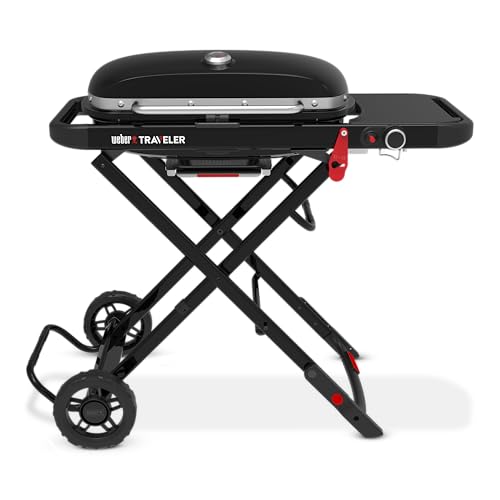
Weber Traveler: Best for Car Camping Without Assembly
A wheeled, one-piece folding grill with a locking lid, for car campers and tailgaters who cook for up to four.
According to Weber, the Traveler has a single 13,000 BTU burner, 320 square inches of cooking area, and weighs 49 pounds. The grill folds into one locked piece with wheels and a lever that raises or lowers it with one hand. Weber says the grate fits 12 burgers or 15 sausages and feeds up to 4. The lid locks automatically when folded. Weber lists a 5-year limited warranty. The trade-off is size and weight: Weber lists it as 43.6 inches wide with the lid closed. Measure your cargo space, and check the manual for the fuel hookup. See our Weber Traveler profile.
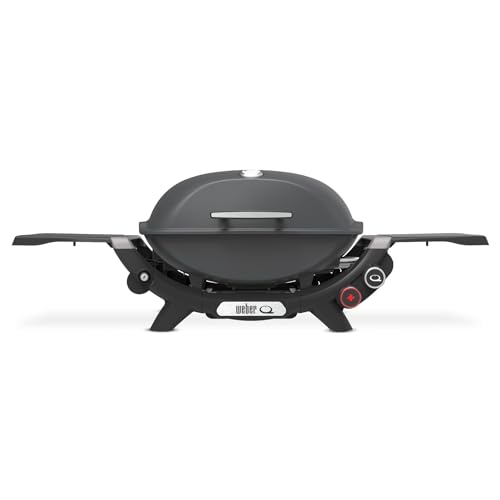
Weber Q 2800N+: Best for Heat Range
A compact grill with a main burner and a Plus burner, for campers with a stable table and a larger fuel setup.
Weber lists an 18,000 BTU main burner, a 4,000 BTU Plus burner, a 250 to 700°F range, 320 square inches of cooking area and a weight of 31.6 pounds. The Plus burner alone holds a low heat for baking or slow roasting, and with the main burner it can sear. The side tables detach and stow in the cradle. As noted above, Weber does not recommend a 1 lb tank adapter for this grill. It sits on a table or a stand sold separately. Read the Q 2800N+ profile for details.
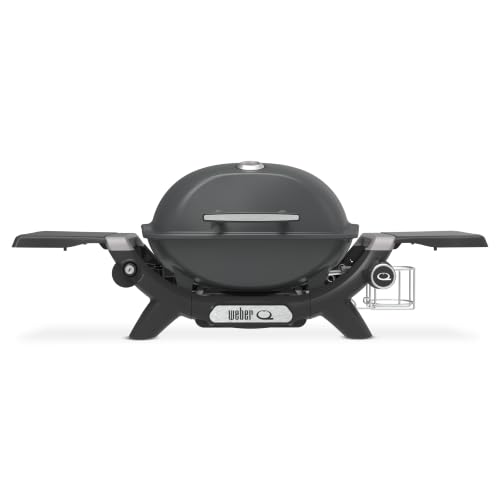
Weber Q 1200N: Best for Small Groups and Lighter Packing
A compact tabletop Weber for one to three people, with a lid thermometer, push-button ignition and detachable side tables.
Weber says the Q 1200N is 40% smaller than the Q 2800N and fits up to 9 burgers made with a Weber burger press. It has porcelain-enameled cast-iron grates, a high-dome lid, a lid thermometer and electronic push-button ignition, and a 5-year limited warranty. Weber’s page does not list BTU output, a cooking area in square inches or weight, so confirm those in the manual. See the Q 1200N profile.
Magma Marine Kettle: Best for Boats and Rail Mounts
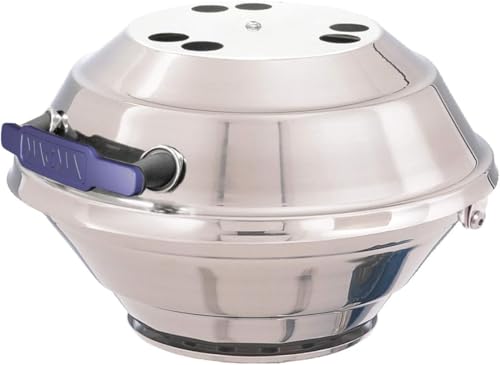
A lightweight stainless kettle with a 1 lb canister burner, designed for boat, pontoon and RV rail mounts.
Magma lists a 10,700 BTU burner, 133 square inches of cooking area, 7.73 pounds and a 1-year warranty. It uses 1 lb canisters, with 2 to 4 hours of burn time per canister at recommended temperatures. Mounts are sold separately, so you need to choose one for your rail, rod holder or table. It adapts to onboard propane or natural gas only with a valve sold separately, and a fixed fuel line is a job for a qualified installer following Magma’s instructions. Use it in open air on an exterior mount, never in a cabin. See the Magma Marine Kettle profile.
Quick Comparison
| Grill | Burner output | Cooking area | Weight | Best for |
|---|---|---|---|---|
| Weber Traveler | 13,000 BTU (1 burner) | 320 sq in | 49 lb | Car camping, no assembly |
| Weber Q 2800N+ | 18,000 BTU + 4,000 BTU Plus | 320 sq in | 31.6 lb | Heat range, small patios |
| Weber Q 1200N | Not listed by Weber | Fits 9 burgers | Not listed | Small groups |
| Magma Marine Kettle | 10,700 BTU | 133 sq in | 7.73 lb | Boats, rail mounts |
How to Choose
If you drive to the campsite and want the easiest setup, the Traveler is the straightforward pick. If you want more heat range and have a table and a suitable fuel setup, the Q 2800N+ is the stronger cooker. If you travel light and cook for two or three, the Q 1200N is the fit. If you boat or want a mount-based grill, the Magma is built for that. If you plan to cook for six or more, or you want a grill for the house too, see our gas grill ranking for 2026 for full-size options.
Sources
Frequently asked questions
Can I use a gas grill inside my RV, camper or tent?
No. NFPA says propane and charcoal grills should only be used outdoors. Cook outside, well away from the camper, awnings, tents and anything that can burn.
Should I buy a grill that uses 1 lb cylinders or a 20 lb tank?
It depends on the grill. Small grills with a lower-BTU burner can work on 1 lb canisters, for example the Magma Marine Kettle at 10,700 BTU. Weber says it does not recommend a 1 lb adapter for the Q 2800N+ because its 18,000 BTU burner can hurt performance on a small disposable cylinder. Use the fuel setup in the owner's manual.
How big a grill do I need for camping?
For one to three people, a grill with about 130 to 320 square inches of cooking area is enough. Weber says the Traveler grate fits 12 burgers and feeds up to 4. Magma says the Marine Kettle serves 4 on 133 square inches.
Do campgrounds allow propane grills?
Many do, but rules vary. Some parks and fire districts restrict open flames in dry or windy conditions, and some limit grills to the fire ring or camp pad. Check the campground's rules and any current fire restrictions before you go.
How do I check my grill for gas leaks before a trip?
NFPA says to apply a light soap-and-water solution to the gas hose at the start of each grilling season. Bubbles mean a leak. Follow the leak-check steps in your owner's manual, and if a leak does not stop when you turn the gas off at the tank, call the fire department.
What is the lightest option here?
The Magma Marine Kettle, at 7.73 pounds according to Magma. Among the Weber grills, the Q 2800N+ is listed at 31.6 pounds and the Traveler at 49 pounds. Weber does not list a weight for the Q 1200N.