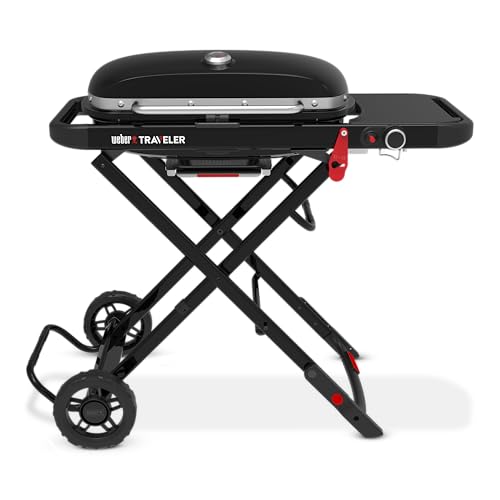
The Weber Traveler is a portable gas grill that folds into a single locked piece with wheels, built for campgrounds, tailgates and beach days rather than the back patio. It is a mid-range pick in a field where the cheapest portable grills are small tabletop units. The Traveler aims to give you something closer to a full grill that is still easy to haul. This profile goes through what Weber publishes, what the numbers mean in practice, and who should look at something smaller or larger. For the wider field, see our gas grill ranking for 2026.
A note on sources. We compared the specifications on Weber’s own product page for part number 1501740 and on the NFPA grilling safety tip sheet. We have not handled the grill, and we do not list any measurement that is not on a page we opened.
What Weber Says About the Traveler
According to Weber’s product page and spec table:
- Burner: one stainless steel main burner, rated at 13,000 BTU per hour.
- Primary cooking area: 320 square inches, on porcelain-enameled cast-iron grates.
- Capacity: Weber says the grate fits 12 burgers or 15 sausages and feeds up to 4 people.
- Weight: 49 pounds, with Weber’s copy saying “less than 50 lbs.”
- Size, lid closed: 37.2 inches high, 43.6 inches wide and 23 inches deep.
- Size, lid open: 50 inches high, 43.6 inches wide and 26 inches deep.
- Ignition: push-button.
- Design: one-piece frame that raises and lowers with one hand using a lever, with a lid that locks automatically when folded down.
- Extras: wheels, a side table, a Weber Works side rail for snap-on accessories (sold separately), front-access grease removal and a porcelain-enameled lid.
- Warranty: 5-year limited.
Weber’s headline copy says the grill is “40 inches wide,” while the spec table says 43.6 inches. The difference is probably the frame versus the widest point including the side table, but Weber does not explain it. If your cargo area is tight, plan around the larger number.
How the Fold-Up Design Works
The idea behind the Traveler is simple. Instead of a grill with a separate cart that you break down, the grill and its frame are one piece. You press a lever, and the grill lifts to cooking height with one hand. When you are done and it has cooled, you lower it and the lid locks, so the cooking box and the grate travel closed. Weber says the wheels roll over grass, concrete and dirt trails.
That one-piece approach is the main reason to pick this model over a tabletop grill. You do not need a picnic table, a tailgate or a rock to set it on. The cooking surface is at working height, and the side table gives you a place for a platter or a bottle of oil. It also means there are no legs to set up at every campsite.
The trade-off is size. A tabletop grill can slide under a seat or into a cabinet, but the Traveler, at 49 pounds and more than 43 inches wide, needs a real cargo space. Weber’s own pitch is that it fits “in the back of a truck or SUV,” not in a small trunk. Measure first.
Cooking With One Burner
The Traveler has one burner. That shapes how you cook on it. With a single burner, the whole grate heats up together, with the hottest area over the burner and cooler areas toward the edges. You can still cook plenty of food that way, but you cannot set up two true zones with one side on high and the other off.
Practical ways to work with one burner:
- Start a batch of burgers or sausages over the hottest area and move finished items to the cooler edge.
- Use the lid. Weber describes a porcelain-enameled lid that holds heat, and a closed lid helps for chicken pieces or thicker cuts.
- Cook in rounds rather than loading everything at once. A 320-square-inch grate is enough for a family dinner, but not for a dozen guests.
Weber says the grill’s temperature range lets you sear steaks or roast chicken. That is marketing language, and Weber does not publish a numeric range for the Traveler on its page. For reference, 13,000 BTU per hour is a moderate rating for this size of grate. If you want to compare it against a smaller Weber, the Q 2800N+ lists 18,000 BTU per hour for the main burner on a 320-square-inch surface.
Fuel, Hoses and Camping Rules
The Weber page for the Traveler does not describe the fuel supply, so we will not guess. Check the owner’s manual and the product listing for the fuel type, regulator and hose it takes, and for whether a 1-pound cylinder, a larger refillable tank or both are supported. Buy any adapter from the maker’s list for this model rather than a generic one.
Safety rules apply no matter which cylinder you use. The National Fire Protection Association (NFPA) says propane and charcoal grills should be used outdoors only. At a campsite, that means never cooking inside a tent, a camper, a vehicle or a garage. NFPA also says to place the grill well away from the home, deck railings, eaves and overhanging branches, and to keep children and pets at least 3 feet from the grill area. At a campground, apply the same thinking to tents, awnings, picnic shelters and dry brush. Check the campground’s own rules, because some parks and fire districts restrict open flames during dry periods.
NFPA also advises checking the gas hose for leaks at the start of each grilling season: apply a light soap-and-water solution to the hose, and bubbles mean a leak. Follow the leak-check procedure in Weber’s manual. If you smell gas while cooking, NFPA says to get away from the grill and call the fire department. Never leave a lit grill unattended, and open the lid before lighting.
Cleaning and Care
Weber lists front-access grease removal, which means you slide out a tray from the front instead of reaching under the grill. For camping, that matters. Grease left in the tray attracts animals and can feed a flare-up. NFPA recommends removing grease or fat buildup from the grates and the trays below the grill. Let the grill cool fully before you fold it and lock the lid, and dispose of the grease properly.
Weber sells a cargo protector and drip pans as accessories. The listing also shows a griddle made for the Traveler, sold separately. If you plan to cook breakfast on the road, the griddle is the add-on to look at. Every accessory is a separate purchase.
Who Should Buy It
This grill fits you if:
- You camp or tailgate by car and want a grill that rolls and folds without assembly each time.
- You cook for two to four people and want a larger surface than a tabletop model.
- You want a lid that locks closed for travel.
- You like Weber’s accessory system and may add a side-rail accessory or a griddle later.
Who Should Look Elsewhere
You may be happier with something different if:
- You want to travel light. A Weber Q 1200N is a smaller, simpler tabletop grill for solo trips and small groups.
- You cook for a crowd. One burner and 320 square inches fill up quickly. A full-size cart grill from our ranking is a better match.
- You boat. For a rail mount on a boat, see the Magma Marine Kettle, which is designed for that job.
- You need two cooking zones. A grill with two or more burners gives you a hot side and a cool side.
Bottom Line
The Weber Traveler is a practical, mid-range portable grill for people who drive to where they cook. Its strengths are the one-piece fold, the locking lid, the wheels and a cooking area that fits a small group. Its limits are one burner, a weight close to 50 pounds, and a width that needs a real cargo space. Read the manual for the fuel setup, keep it outdoors and well away from anything that can burn, and see how it ranks against bigger grills in our full comparison.
See price on Amazon
Sources