We earn a commission if you buy through our links, at no extra cost to you.
Best Gas Grill for a Patio or Deck
How to pick a propane grill for a patio or wooden deck: footprint, clearances, deck protection, lease and fire code checks, plus four models that fit.
At a glance
For a patio or deck, the Weber Spirit E-325 is the compact three-burner pick with fold-down side tables. The Weber Genesis S-415 adds cooking area for larger decks, and the Broil King Baron 490 Pro Shadow adds a side burner and rotisserie. Keep any grill clear of railings and eaves.
A patio or deck is the most common home for a gas grill, and also the place where a grill causes the most trouble. Space is limited, the surface under the grill matters, the house or railing is close, and in many apartments or HOA communities there is a rulebook before there is a grill. This guide focuses on those practical questions first, then points to models from our list that fit different amounts of space. Specifications come from the makers’ own product pages and from the National Fire Protection Association (NFPA) grilling safety sheet. We do not cite anything we did not open.
Measure the Space Before You Pick a Grill
The most common mistake is buying for cooking area and forgetting the footprint. A grill takes up more room than its cabinet alone. You need space for the lid to swing open, for side tables if you use them, and for you to stand and cook. You also need clearance from the house and railings, which is the next section.
Use the lid-open numbers. The makers publish them:
- Weber Spirit E-325: 60.5 inches high, 48.3 inches wide and 30.97 inches deep with the lid open; 46.2 by 48.3 by 26.6 inches with it closed.
- Weber Genesis S-415: 63 inches high, 64.5 inches wide and 30.6 inches deep with the lid open; 48.1 by 64.5 by 27 inches closed.
- Weber Q 2800N+: 28.87 inches high, 30 inches wide and 26.5 inches deep with the lid open; 16.7 by 30 by 19.7 inches closed.
Broil King’s page for the Baron 490 Pro Shadow lists its weight at 157 pounds, but the page does not give dimensions in the text, so check the spec sheet for the footprint before you buy.
Then mark the footprint on the deck with painter’s tape, include the open lid and a few feet of working room, and see how it fits against your railing, door and furniture.
Clearances: Follow the Manual and NFPA
NFPA’s grilling safety sheet is blunt about placement. Propane grills should be used outdoors only. The grill should be placed well away from the home, deck railings and out from under eaves and overhanging branches. Children and pets should stay at least 3 feet from the grill area.
NFPA does not print a single distance in that sheet, so the number to use is the one in your grill’s owner’s manual. Makers specify minimum clearances to combustible surfaces, and those apply to your siding, railings, fence and any overhead structure. Your local fire code may add its own rules. If the manual and the code differ, follow the stricter one.
A few practical consequences:
- Don’t roll a grill against the house wall to save space, and don’t tuck it under a low roof, awning or covered porch.
- Don’t use a grill on an enclosed porch, in a garage or inside a screened room.
- Open the lid before you light the grill, never leave it unattended and keep a clear path to the door.
- At the start of each grilling season, check the gas hose with a light soap-and-water solution, as NFPA advises. Bubbles mean a leak. Follow the leak-check steps in your manual.
Deck Protection
A grill can drop grease, hot fat and ash. On wood or composite decking, that can stain the surface or start a fire. A fire-resistant grill mat under the grill is a common, inexpensive precaution, and cleaning the grease tray often keeps drips down. NFPA recommends removing grease or fat buildup from the grates and the trays below the grill. Check what your decking maker says about heat and spills, because some composite products are sensitive to heat.
Casters can also scratch or dent decking. Locking casters keep the grill from rolling, which matters on a slightly sloped deck.
Lease, HOA and Fire Code
Before you buy, check three things. First, your lease or HOA rules, which often ban propane grills on balconies, decks above ground level or within a set distance of buildings. Second, your local fire code, which may restrict propane grills on balconies and upper-floor decks in multifamily buildings. Third, your insurance, in case the policy has conditions. We do not cite specific code sections because they differ by city and by state. Ask your landlord, property manager or the local fire department what applies to you. If propane is not allowed, an electric grill may be the answer, but that is outside the scope of this list.
A natural gas hookup is a job for a licensed gas fitter or plumber, following the manufacturer’s installation instructions. Some grills on our list are also sold in natural gas versions. Never try to convert a propane grill or run a gas line yourself.
Our Picks for a Patio or Deck
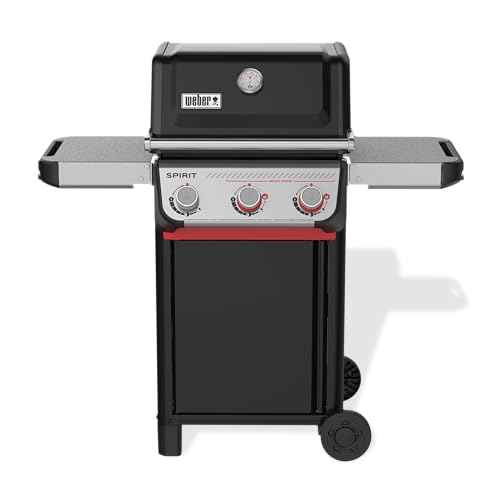
Weber Spirit E-325: Best for Most Patios
A compact three-burner grill with fold-down side tables and a cabinet that hides the propane tank, for patios and smaller decks.
Weber lists 31,000 BTU per hour on the main burners and 450 square inches of total cooking area (360 primary plus a 90-square-inch warming rack). Two Boost Burner knobs give 40% more power in the Sear Zone, according to Weber. The side tables are hammertone metal and fold down for smaller spaces. A cabinet with a door hides the tank. Weber lists a 10-year limited warranty, and the page shows both liquid propane and natural gas versions. At 48.3 inches wide, it suits a normal patio. See our Weber Spirit E-325 profile.
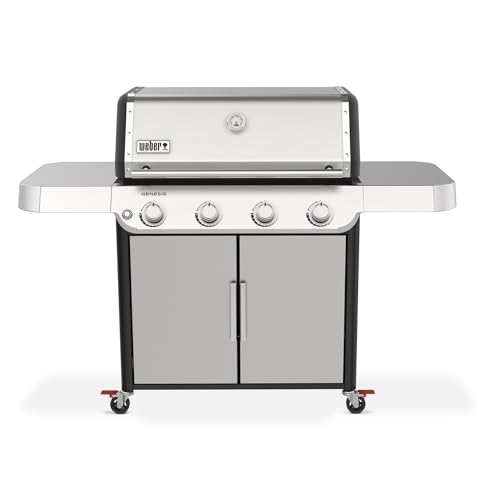
Weber Genesis S-415: Best for a Larger Deck
A four-burner stainless steel grill with 820 square inches of total cooking area, for larger decks where you cook for a crowd.
Weber lists four PureBlu burners at 48,000 BTU per hour, 646 square inches of primary cooking area and 174 square inches of warming rack, for 820 total. Stainless steel cooking grates and a Sear Zone with Boost Burner knobs are part of the package. The cost is its footprint: 64.5 inches wide and 63 inches tall with the lid open. Read Weber’s warranty page for the terms. See the Genesis S-415 profile.
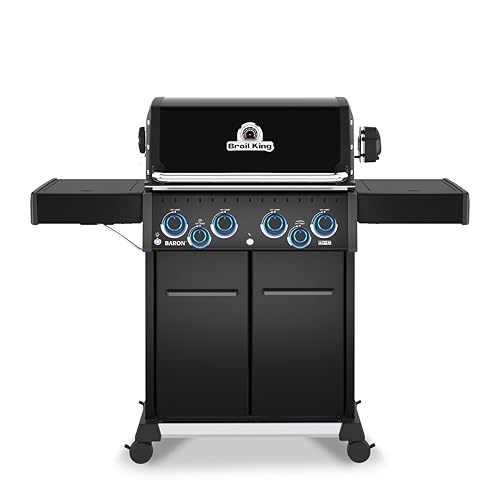
Broil King Baron 490 Pro Shadow: Best for Features on a Spacious Deck
A four-burner grill with a side burner, a rear rotisserie burner and locking casters, for a deck with room to spare.
Broil King lists four Dual-Tube burners at up to 40,000 BTU, a 10,000 BTU side burner and a 15,000 BTU rear rotisserie burner with kit, and 630 square inches of total cooking space including 460 primary. The cabinet has large locking casters and drop-down side shelves, and the grill weighs 157 pounds. The page lists a Limited Lifetime cookbox warranty and a 15-year warranty on parts and paint. Weight matters on a deck, so confirm your deck can support it. Our Baron 490 Pro Shadow profile has more.
Weber Q 2800N+: Best for a Tiny Patio
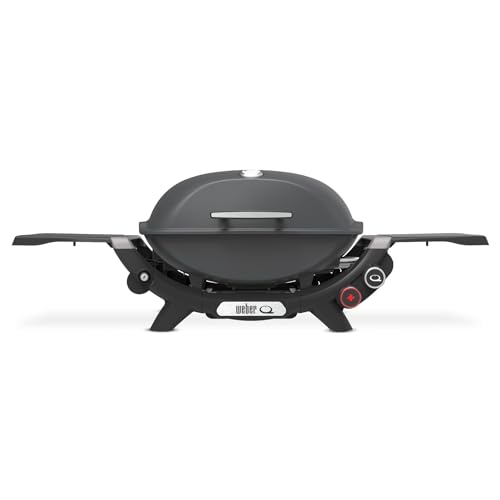
A compact grill with a Plus burner and a high-dome lid, for small patios and cooks who only feed a few people.
At 30 inches wide and 31.6 pounds, according to Weber, it is the smallest option here. Weber lists 320 square inches of cooking area, an 18,000 BTU main burner, a 4,000 BTU Plus burner and a 250 to 700°F range. It needs a stable table or a stand sold separately. Weber says it fits on a porch or balcony, but that does not mean your building allows it, so check your lease first. See the Q 2800N+ profile.
Quick Comparison
| Grill | Main burner output | Total cooking area | Width, lid open |
|---|---|---|---|
| Weber Spirit E-325 | 31,000 BTU | 450 sq in | 48.3 in |
| Weber Genesis S-415 | 48,000 BTU | 820 sq in | 64.5 in |
| Broil King Baron 490 Pro Shadow | Up to 40,000 BTU | 630 sq in | Not listed |
| Weber Q 2800N+ | 18,000 BTU + 4,000 BTU Plus | 320 sq in | 30 in |
How to Choose
For a typical patio, the Spirit E-325 balances size and capability. If you have a large deck and cook for guests, the Genesis S-415 or the Baron 490 Pro Shadow give you more room and features. If your patio is tiny and your building allows propane, the Q 2800N+ is the compact choice. Measure first, read the clearances in the manual, and check your lease and local rules. For the full list, including entertaining and portable grills, see our gas grill ranking for 2026.
Sources
Frequently asked questions
How far should a gas grill be from my house and deck railing?
NFPA says to place propane and charcoal grills well away from the home, deck railings, eaves and overhanging branches. Its tip sheet gives no single distance, so follow the clearances printed in your grill's owner's manual and your local fire code, whichever is stricter.
Can I use a propane grill on a balcony?
Only if your lease, HOA and local fire code allow it. Many apartment buildings and some cities prohibit propane grills on balconies. Check with your landlord or the local fire department before you buy, because rules vary by town.
Do I need a deck mat under my grill?
A fire-resistant, grease-catching mat or pad under the grill is a common precaution on wood or composite decking, because grease and hot debris can drop below the grill. Check what your grill's manual and your decking maker say about heat and placement.
How much room does a full-size grill need?
Allow for the lid-open size, the side tables and working space around it. Weber lists the Spirit E-325 at 60.5 inches high and 48.3 inches wide with the lid open, and the Genesis S-415 at 63 inches high and 64.5 inches wide, which is a big difference on a small deck.
Is a small grill enough for a tiny patio?
For one to four people, yes. The Weber Q 2800N+ is 30 inches wide with the lid open and has 320 square inches of cooking area, according to Weber. Make sure the surface it sits on is stable and heat-tolerant, and that your building allows propane.
What gas leak check should I do each year?
NFPA says to check the gas tank hose at the start of each grilling season by applying a light soap-and-water solution. Bubbles mean a leak. Follow your owner's manual for the exact steps.